

AI Can Start Your AV Project. It Shouldn’t Finish It.
It’s becoming common for a pastor, a facilities manager, or an IT director to open ChatGPT before they ever call an AV company. They type in something like “what sound system do I need for a 400-seat church” and get back a confident answer with brand names, a gear list, and a budget range.
We think that’s a good start. People should do their homework. But after more than 25 years of designing and installing commercial AV systems, our position is simple: AI can help you start an AV project. It shouldn’t be the thing that makes the decision.
Where AI actually helps
Used the right way, AI is a useful research tool. It can:
- Teach you the vocabulary (DSP, line array, Dante, PoE) so you can follow the conversation with an integrator
- Give you a rough sense of what’s possible for your type of space
- Help you put together a list of questions before you talk to anyone
- Explain the difference between approaches at a high level
We’d encourage anyone planning a project to use it for those things. You’ll walk into the first conversation better prepared.
What AI can’t do
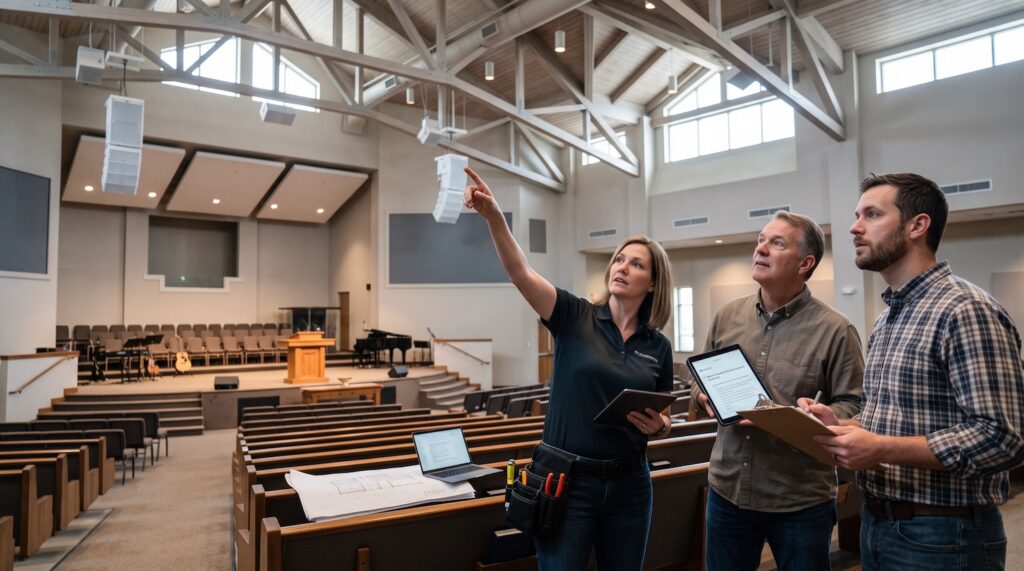
It hasn’t been in your room. Every space has its own problems. A sanctuary with a high ceiling and hard plaster walls behaves nothing like a carpeted conference room. Reflections, HVAC noise, sightlines from the back row, where the power and network cabling actually run. None of that makes it into a prompt unless you know to include it, and most people don’t know what to look for. That’s not a knock on anyone. Seeing those things is what we’re trained to do.
It sounds just as sure when it’s wrong. AI will recommend a specific mixer, projector, or camera with complete confidence. That product might be discontinued. It might be consumer-grade gear that won’t hold up to daily use. It might not work with the equipment you already own. You usually find out after it’s installed.
It doesn’t know your rules. ADA assistive listening requirements, electrical and fire codes, your building’s IT and security policies. These details rarely show up in a chatbot answer. They show up later as change orders.
It doesn’t own the outcome. When the livestream drops two minutes before Sunday service, or the boardroom display won’t connect before a board meeting, the chatbot isn’t answering the phone.
No band-aids
The biggest risk of designing a system from an AI answer isn’t one bad purchase. It’s ending up with a patchwork. One piece from this recommendation, another from that one, all connected by whoever was available to plug it in. Every fix creates a new problem, and before long nobody on staff fully understands how the system works.
Commercial AV is a long-term investment. The decisions made at the design stage determine how reliable the system is for years. That’s why we build standardized, commercial-grade systems. Your team learns them once, they behave the same way every time, and service is predictable.
What a trusted advisor does differently
A good AV partner starts with a walk-through, not a gear list. We want to see the space, hear how it gets used, who runs it, and what has worked or failed in the past.
From there, the conversation is about outcomes. A church wants the message to reach every seat in the room and every viewer online. An IT director wants systems that don’t generate support tickets. A business owner wants technology that pays for itself. A facilities manager wants it to work and look right every day. The equipment comes after those answers, not before.
And a trusted advisor is still there after the install. Support, maintenance, and our Service Preservation Program keep the system running the way it was designed to run.
How to use both
You don’t have to choose between AI and an integrator. Here’s the approach we’d recommend:
- Use AI to learn the language and build your list of questions.
- Write down the outcome you need, in plain terms. What should be different when the project is done?
- Bring both to a walk-through with an experienced integrator.
- Ask the integrator to explain anywhere their recommendation differs from what AI told you. A good partner will have a clear answer.
Bring your AI research to us. We’re happy to go through it with you and tell you what holds up in your space and what doesn’t.
Start with a walk-through
Audio-Video Group has designed and installed commercial AV systems across Maryland, Virginia, DC, Pennsylvania, and West Virginia since 2000. If you’re planning a project for a house of worship, corporate office, school, or healthcare facility, the best first step is a walk-through of your space. Call us at 1.800.668.4988 or request a walk-through below.
Frequently Asked Questions
Can I use ChatGPT to design my church or office AV system?
You can use it to learn the terms and build a list of questions. It can’t see your room, check your existing equipment, or account for acoustics and building codes, so the final design should come from an experienced integrator who has walked the space.
Why do AI equipment recommendations sometimes fail after installation?
AI often recommends products without knowing your room size, acoustics, existing gear, or how often the system is used. The result can be discontinued products, consumer-grade equipment, or components that don’t work together.
What happens during an AV walk-through?
An integrator visits your space, looks at the room, power, and network infrastructure, and talks with the people who use and run the system. The goal is to understand the outcome you need before recommending any equipment.
Should I bring my AI research to an AV integrator?
Yes. It’s a good starting point for the conversation. A trusted integrator will tell you what holds up in your space and explain where their recommendation differs.
Who designs commercial AV systems in Maryland, Virginia, and DC?
Audio-Video Group, based in Frederick, Maryland, has designed and installed commercial AV systems since 2000 for houses of worship, corporate offices, schools, and healthcare facilities across Maryland, Virginia, DC, Pennsylvania, and West Virginia.